LRO narrow-angle camera products georeference hardware and surface disturbance at the published coordinates for Sea of Tranquility. Featured-site pages and catalogue links below point to the same releases cited on the Evidence page. All six Apollo sites from orbit lists every crewed zone with LROC featured links in one table.
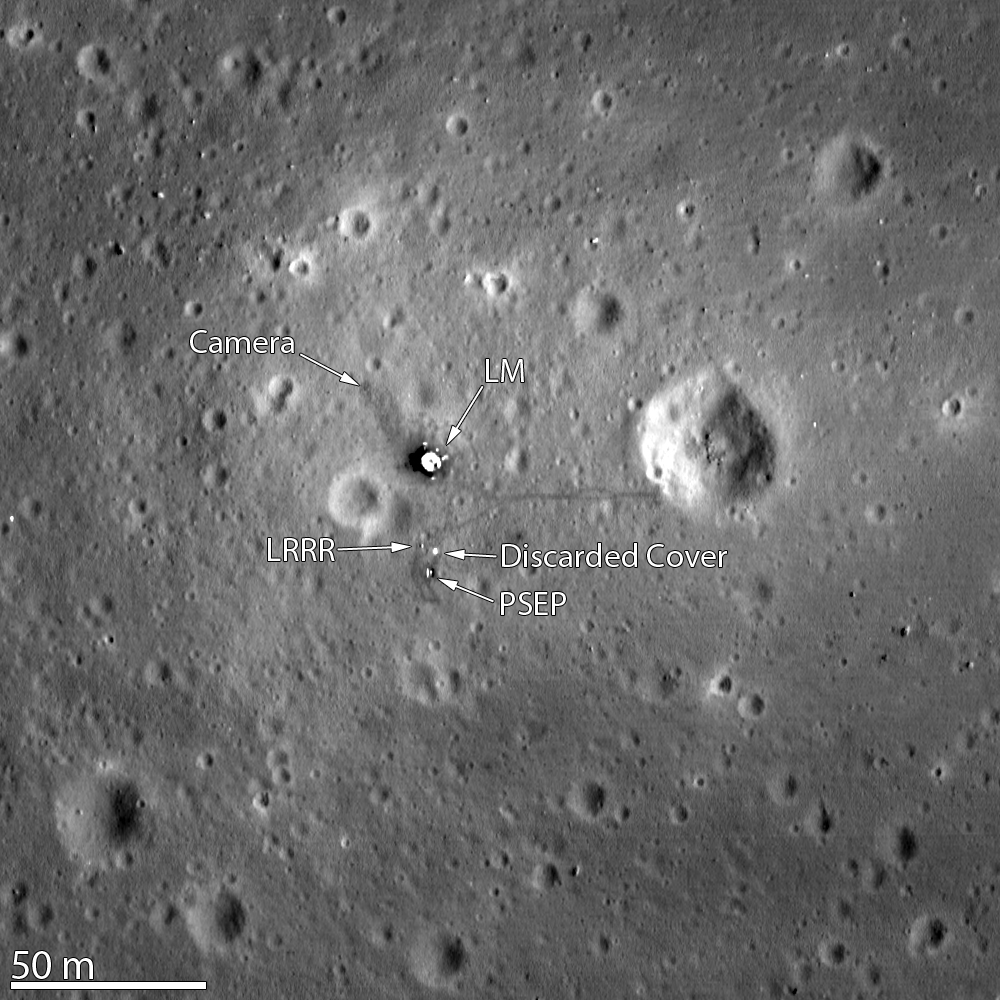
Lunar Reconnaissance Orbiter narrow-angle context of Tranquility Base—hardware and disturbance match EVA logs.
Narrow-angle LRO passes show the descent stage, experiment deployment zones, and footpaths that align with EVA timelines and Hasselblad panoramas.
Active laser ranging target
The Apollo 11 LRRR remains in global LLR networks; timing residuals anchor the array to published selenographic coordinates.
Photo-transcript cross-links
The Apollo Lunar Surface Journal ties magazine frames to air-to-ground audio, enabling independent reconstruction of crew positions.
Curated sample return
Returned materials are indexed through JSC with collection context tied to documented geology stops on the surface.
Lunar laser ranging
Apollo 11 Retroreflector
Array of corner cubes still used in laser ranging.
Deployed 1969-07-20
Selected frames
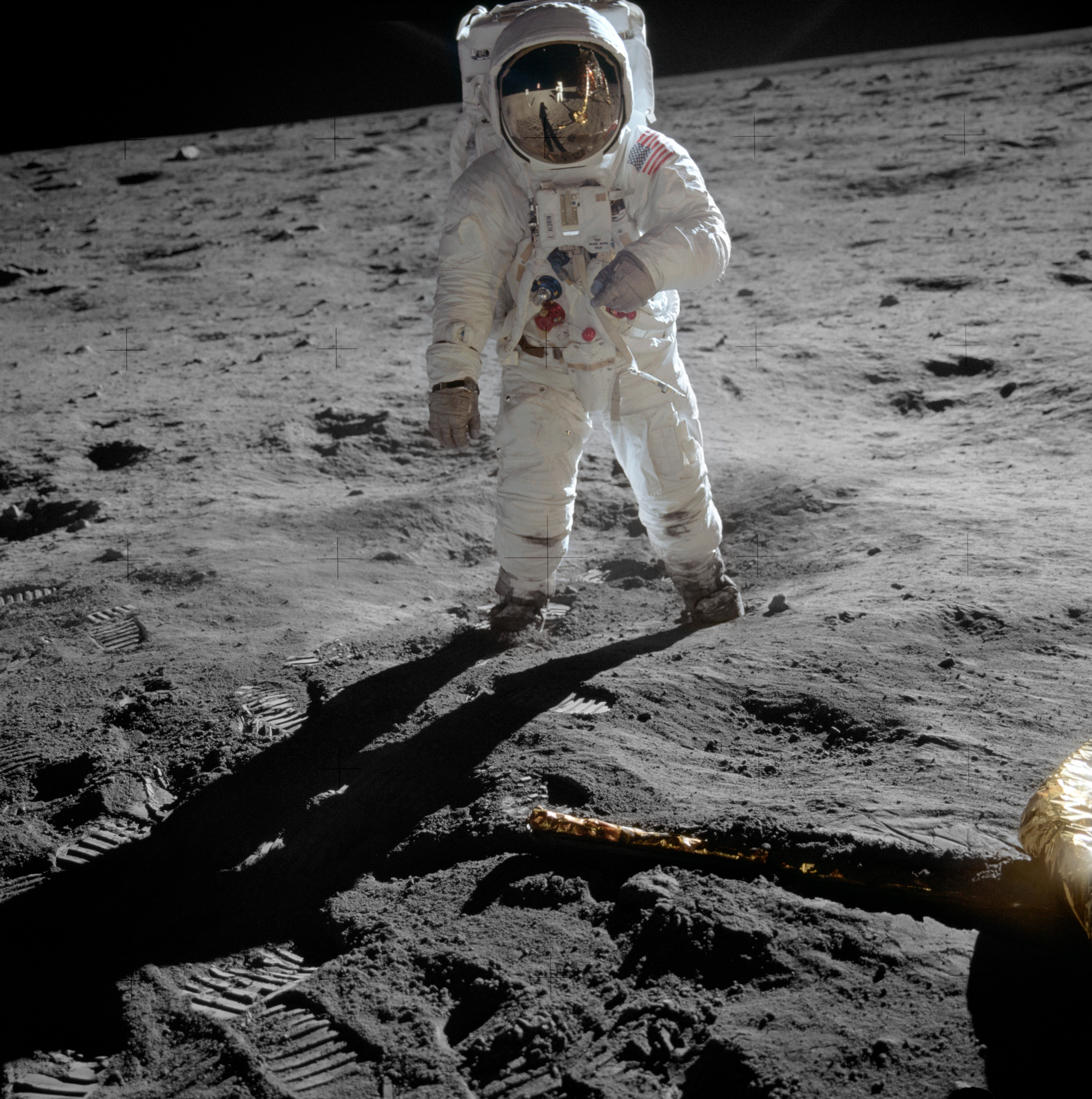
Regolith disturbance documented on the surface.
NASA
Corner-cube array at a published selenographic position.
NASA (National Archives)
Mission identity in the contemporaneous program record.
NASA
Common questions about evidence for this landing
Factual shortcuts—full citations sit in the sections above and in mission source links.
What do LRO and LROC images show at Sea of Tranquility?
Published Lunar Reconnaissance Orbiter Camera (LROC) narrow-angle products resolve hardware, experiments, and regolith disturbance at the selenographic coordinates on this page. Use the orbital section above and the official LROC / NASA links under “Official sources” for the featured-site and data-product pages for Apollo 11.
Did Apollo 11 leave a laser-ranging retroreflector on the surface?
Yes. This flight deployed an Apollo laser ranging package still timed by Earth observatories. See the lunar laser ranging callout in the evidence section, then follow NASA and ILRS references from the Sources index and the retroreflector catalogue.
Where can I read how this evidence fits the wider Apollo record?
The How we know page summarizes independent lines of proof. The Evidence catalogue groups LRO imagery, hardware, LLR, photo comparisons, and NASA documents with primary links.
Site imagery
Curated in explorer Site Detail
Apollo 11 — Tranquility Base. Use the explorer’s Site detail tab for the same rasters, or open the official product pages below.
Site map
Site map — regional NAC (LROC post 157, Tranquility Base)
Official LROC Apollo landing sites release (July 2009, post 157): ~1 km-scale narrow-angle frame centered on Tranquility Base and West crater within Mare Tranquillitatis.
Low-altitude NAC — “best look yet” at the landing site
LRO narrow-angle observation from ~24 km altitude (Goddard release “A Stark Beauty All Its Own”): LM, PSEP, LRRR, cover foil, and footpaths toward the experiments and toward Little West crater are visible at full zoom (M175124932R product family).
First lunar landing mission: Armstrong and Aldrin landed LM Eagle at Tranquility Base, completed one surface EVA, deployed the first passive seismic package and laser retroreflector, and returned 21.55 kg of documented samples while Collins orbited in Columbia.
Key achievements
First crewed lunar landing
First moonwalk in human history
Deployed early surface experiments
Placed retroreflector still used today
Surface hardware & experiments
Passive Seismic Experiment
Laser Ranging Retroreflector
Solar Wind Composition Experiment
Timeline highlights
July 16, 1969
Saturn V launch & translunar injection
SA-506 lifts from KSC Pad 39A; the S-IVB TLI burn sends Columbia and Eagle toward the Moon on a free-return trajectory.
July 19–20, 1969
Lunar orbit capture & checkout
LOI places the stack in lunar orbit; the crew performs landmark tracking, LM activation, and separation planning before powered descent.
July 20, 1969
Powered descent & first EVA
Eagle lands at Tranquility Base (~20:17 UTC). Armstrong and Aldrin deploy experiments, collect samples, and photograph the site before lunar ascent.
July 24, 1969
Transearth coast & Pacific recovery
Columbia splashes down; crew and sealed sample containers are recovered under published quarantine and curation protocols.
Official sources
Primary portals and data releases for verifying mission-specific claims. Cross-check themes on the Evidence catalogue and the wider How we know overview when you need category-level context.