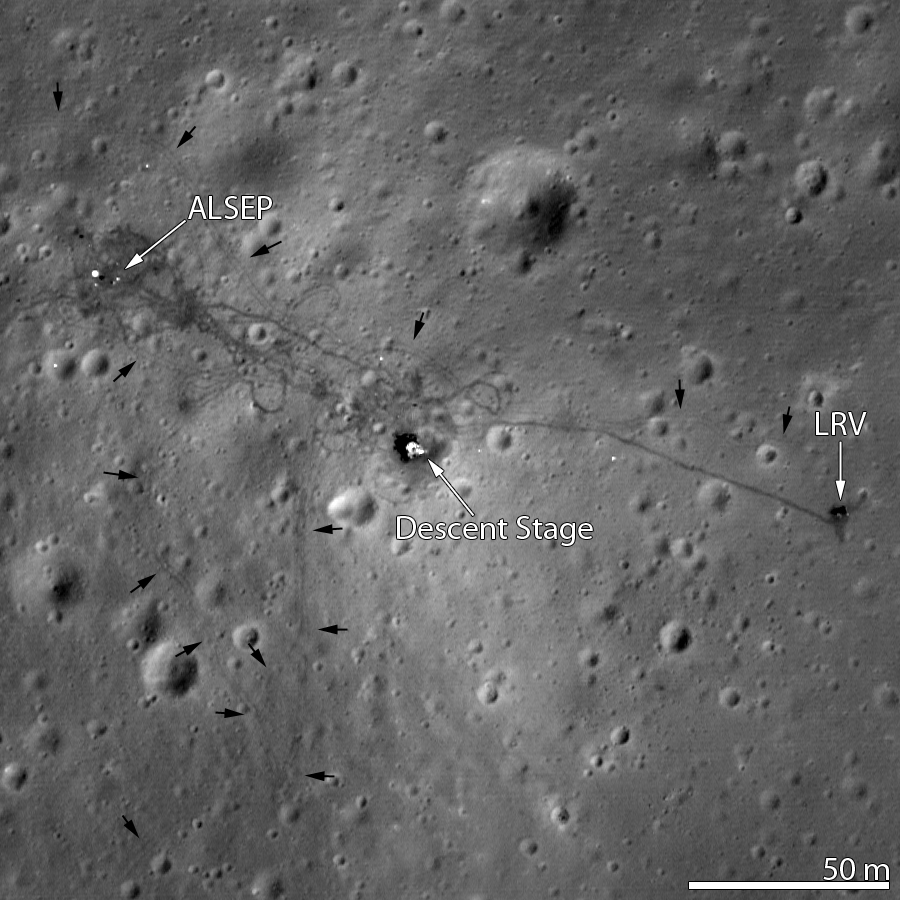
LRO narrow-angle camera products georeference hardware and surface disturbance at the published coordinates for Hadley Rille. Featured-site pages and catalogue links below point to the same releases cited on the Evidence page. All six Apollo sites from orbit lists every crewed zone with LROC featured links in one table.
Orbital pass resolving the lunar module, experiments, and wheel paths from Hadley–Apennine.
Campaign imagery shows wheel paths, parked LRV geometry, and crew paths between Falcon, ALSEP, and geology stops.
Regional context at the rille margin
Post-157 and later strips place the landing point in geomorphic context beside Hadley Rille and the massifs.
Largest Apollo retroreflector array
Apollo 15’s LRRR is the highest cross-section Apollo array in routine LLR solutions—still interrogated from Earth.
Documented cislunar operations
Deep-space EVA procedures, timing, and film recovery are preserved in mission logs independent of surface photography.
Lunar laser ranging
Apollo 15 Retroreflector
Largest Apollo reflector array in routine use.
Deployed 1971-07-31
Selected frames
Crew and LRV in the surface record.
NASA
Surface experiment package in situ.
NASA
Regional LROC context at the landing zone.
NASA / Goddard / Arizona State University (LROC)
Common questions about evidence for this landing
Factual shortcuts—full citations sit in the sections above and in mission source links.
What do LRO and LROC images show at Hadley Rille?
Published Lunar Reconnaissance Orbiter Camera (LROC) narrow-angle products resolve hardware, experiments, and regolith disturbance at the selenographic coordinates on this page. Use the orbital section above and the official LROC / NASA links under “Official sources” for the featured-site and data-product pages for Apollo 15.
Did Apollo 15 leave a laser-ranging retroreflector on the surface?
Yes. This flight deployed an Apollo laser ranging package still timed by Earth observatories. See the lunar laser ranging callout in the evidence section, then follow NASA and ILRS references from the Sources index and the retroreflector catalogue.
Where can I read how this evidence fits the wider Apollo record?
The How we know page summarizes independent lines of proof. The Evidence catalogue groups LRO imagery, hardware, LLR, photo comparisons, and NASA documents with primary links.
Site imagery
Curated in explorer Site Detail
Apollo 15 — Hadley–Apennine. Use the explorer’s Site detail tab for the same rasters, or open the official product pages below.
Site map
Site map — regional NAC (LROC post 157, Hadley–Apennine)
Official LROC Apollo landing sites release (July 2009, post 157): ~1 km-scale narrow-angle frame of Hadley Rille and the Apollo 15 valley landing corridor.
NASA Goddard LROC NAC release from the 2011 low-altitude campaign: lunar module *Falcon*, ALSEP vicinity, and rover / astronaut tracks across the mare basalt—strong single-frame surface evidence.
First J-mission: Falcon landed at Hadley–Apennine with the first LRV, enabling three long EVAs, deep drilling, and the largest Apollo sample mass to that point. Worden conducted a stand-up EVA in cislunar space during transearth coast.
Key achievements
First use of LRV
Deep-space EVA during return
Genesis Rock discovery
Surface hardware & experiments
Lunar Roving Vehicle
ALSEP
Lunar surface drill
Timeline highlights
July 26, 1971
Launch & translunar coast
Saturn V delivers Endeavour, Falcon, and LRV to the Moon with extended consumables for surface operations.
July 30, 1971
Landing at Hadley–Apennine
Falcon sets down near Hadley Rille; crew unstows the rover and begins the first long-baseline geology campaign.
July 31 – August 2, 1971
Three rover-supported EVAs
Traverses reach Apennine Front outcrops and mare basalts; ALSEP and the third Apollo LRRR are deployed; deep core samples are attempted.
August 7, 1971
TEI, deep-space EVA, splashdown
Transearth coast includes SIM bay science and Worden’s stand-up EVA to retrieve film cassettes; Pacific recovery closes the mission.
Official sources
Primary portals and data releases for verifying mission-specific claims. Cross-check themes on the Evidence catalogue and the wider How we know overview when you need category-level context.